NASA’s Swift Telescope Ends 22-Year Mission in Reentry
NASA’s Swift Telescope Ends 22-Year Mission in Fiery Reentry
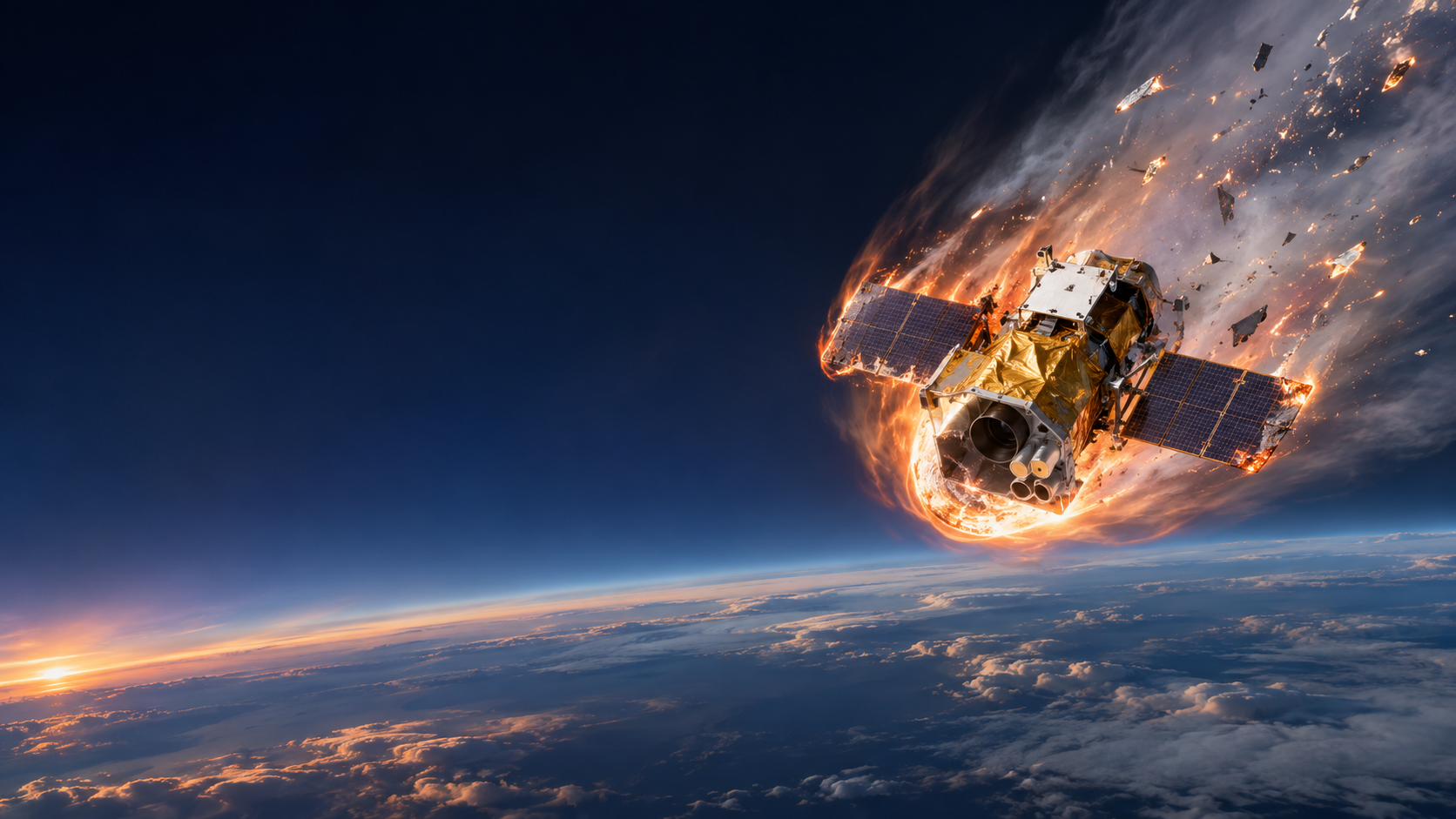
NASA’s 22-year-old Swift satellite telescope has reentered Earth’s atmosphere, bringing its mission to an end. The spacecraft spent more than two decades studying gamma-ray bursts and other short-lived, high-energy events across the universe. Source 1
The reentry was the final physical stage of a long-running space mission. As Swift lost altitude, it encountered increasingly dense layers of the atmosphere. Drag, heat and aerodynamic stress eventually destroyed the spacecraft.
What Happened to NASA’s Swift Satellite?
Swift did not fall vertically from orbit. It continued traveling around Earth while gradually losing altitude through a process called orbital decay. As the spacecraft descended, atmospheric drag increased and removed more energy from its orbit.
Eventually, Swift reached atmospheric layers dense enough to generate intense heating and structural stress. Components weakened, fragmented and burned during the final descent.
The process had three main stages:
- Orbital decay: A gradual reduction in altitude.
- Atmospheric reentry: The spacecraft’s descent into denser air.
- Spacecraft breakup: Destruction caused by heat and aerodynamic forces.
The reentry marked the end of Swift’s mission, although the available reporting does not identify one specific technical reason for its retirement. Aging hardware, limited fuel, declining power, communications problems and operational decisions can all contribute to the conclusion of a space mission. Source 3
The phrase “fiery finale” describes the spacecraft’s destruction in the atmosphere. It does not indicate a sudden explosion or a new astronomical event in space.
What Was NASA’s Swift Telescope?
Swift was designed to detect and study gamma-ray bursts, brief flashes of extraordinarily powerful energy from distant cosmic events. Some bursts are associated with the deaths of massive stars, while others may result from mergers involving compact objects such as neutron stars and black holes.
Although the initial burst may last only seconds or minutes, it can produce an afterglow visible at other wavelengths. Swift’s ability to detect a burst, determine its location and rapidly alert other observatories made it especially valuable.
Its mission combined:
- Detection of high-energy bursts.
- Rapid determination of their positions.
- Alerts to astronomers and observatories.
- Follow-up observations of fading afterglows.
- Comparison of data across multiple wavelengths.
This approach allowed scientists to study cosmic explosions as they developed rather than observing only their later remnants.
Why Gamma-Ray Bursts Matter
Gamma-ray bursts reveal physical conditions that cannot be reproduced on Earth. They can provide insight into the deaths of massive stars, the formation of black holes and the behavior of compact objects during catastrophic mergers.
Because many bursts occur in distant galaxies, their light also serves as a probe of the early and distant universe. The signal can contain information about the explosion, the material surrounding it and the galaxy where it occurred.
Time is critical. The initial flash and its afterglow can fade rapidly, so delayed observations may miss the most informative phase. Swift helped other telescopes respond while these transient signals were still detectable.
How Swift Changed the Study of Cosmic Explosions
Swift functioned as both a space-based detector and a rapid-response observation platform. Once it identified a likely burst, astronomers could direct ground-based telescopes and other space instruments toward the source.
High-energy observations can reveal the initial explosion, while visible, infrared, ultraviolet and X-ray observations can provide information about the afterglow, temperature, motion and surrounding material. Combining these wavelengths creates a more complete picture of the event.
Swift’s value therefore extended beyond the data collected by its own instruments. Each alert could launch an international observing campaign involving multiple facilities and research teams.
A 22-Year Mission
Operating for more than two decades is a significant achievement for a space telescope. Spacecraft endure radiation, repeated temperature changes, mechanical stress and electronic aging. Power systems can degrade, communications can become less reliable and onboard fuel is limited.
Long missions also require ground teams to maintain software, procedures and support infrastructure. Operations may be adjusted as systems age, with teams revising observing schedules or prioritizing the most valuable targets.
Swift’s long service allowed researchers to study rare transient events over changing scientific and technological conditions. Its retirement reflects the finite life of space hardware, not the disappearance of its scientific value.
Why Satellites Burn Up During Reentry
A spacecraft in orbit travels at very high speed. Its forward motion keeps it circling Earth, while atmospheric drag gradually reduces its orbital energy. As its altitude decreases, the atmosphere becomes denser and resistance increases.
Air compressed in front of the spacecraft becomes extremely hot. Aerodynamic forces place additional stress on the structure, causing panels, tanks, instruments and other components to fail. The spacecraft then fragments and loses material through ablation, the removal of material caused by extreme heating.
Some dense components can survive partially, depending on their shape, mass, composition and breakup altitude. The supplied reporting does not establish whether any Swift debris reached the surface, so no debris estimate or impact location should be assumed.
What Swift’s Retirement Means for Astronomy
Swift’s retirement ends one mission, not gamma-ray burst research. Other space observatories and ground-based telescopes will continue searching for high-energy cosmic events and studying their afterglows.
Researchers can also build on Swift’s rapid-response methods and compare its archived observations with data from newer instruments. The mission’s alerts, datasets, published research and follow-up observations will remain useful for years.
A spacecraft’s physical destruction does not erase its scientific record. Archived data can support new discoveries when researchers combine older observations with later measurements or apply new analytical methods.
Swift’s Lasting Legacy
Swift helped establish the importance of rapid, coordinated and multi-wavelength observations of transient cosmic events. Its work connected high-energy detections with follow-up observations across the electromagnetic spectrum.
Its legacy includes more than two decades of observations, alerts that enabled international research campaigns, public datasets, scientific publications and techniques that can guide future observatories.
The spacecraft has left orbit, but the research it enabled continues.
Conclusion
NASA’s Swift satellite operated for approximately 22 years before reentering Earth’s atmosphere and ending its mission. Source 1
The telescope was designed to detect gamma-ray bursts and support rapid follow-up observations of powerful cosmic explosions. Its mission demonstrated the importance of speed, coordination and multi-wavelength astronomy.
Swift’s reentry destroyed the satellite but not its contribution. Its archived observations and scientific legacy will continue supporting research into some of the universe’s most energetic events.
Frequently Asked Questions
What was NASA’s Swift satellite designed to study?
Swift was designed to detect and study gamma-ray bursts, extremely energetic explosions in the universe. It helped astronomers locate these short-lived events and coordinate follow-up observations.
How long did Swift operate?
Swift operated for approximately 22 years before reentering Earth’s atmosphere.
Why did Swift burn up during reentry?
As Swift lost altitude, atmospheric drag and heating increased. The spacecraft eventually broke apart and burned in denser layers of the atmosphere.
Does Swift’s reentry end gamma-ray burst research?
No. Other space observatories, ground-based telescopes and international research programs continue studying gamma-ray bursts.
What made Swift important?
Swift could rapidly detect high-energy events, determine their locations and alert other observatories before their fading afterglows became too faint.
Will Swift’s scientific data remain useful?
Yes. Archived observations, published studies and follow-up research can continue supporting astronomy after the spacecraft’s reentry.
Artikel Terkait
-
 Mars Isn’t Dead: Clues from Recent Volcanism
-
 Starfish Space Loses Contact With Otter Spacecraft
-
 NASA X-70 Fractal: What the Reported Announcement Reveals
-
 Could Mars’s “Extinct” Volcanoes Still Support Life?
-
 NASA’s Swift Telescope Reenters After 22-Year Mission
-
 2026 Ozone Hole Was Largest in a Decade