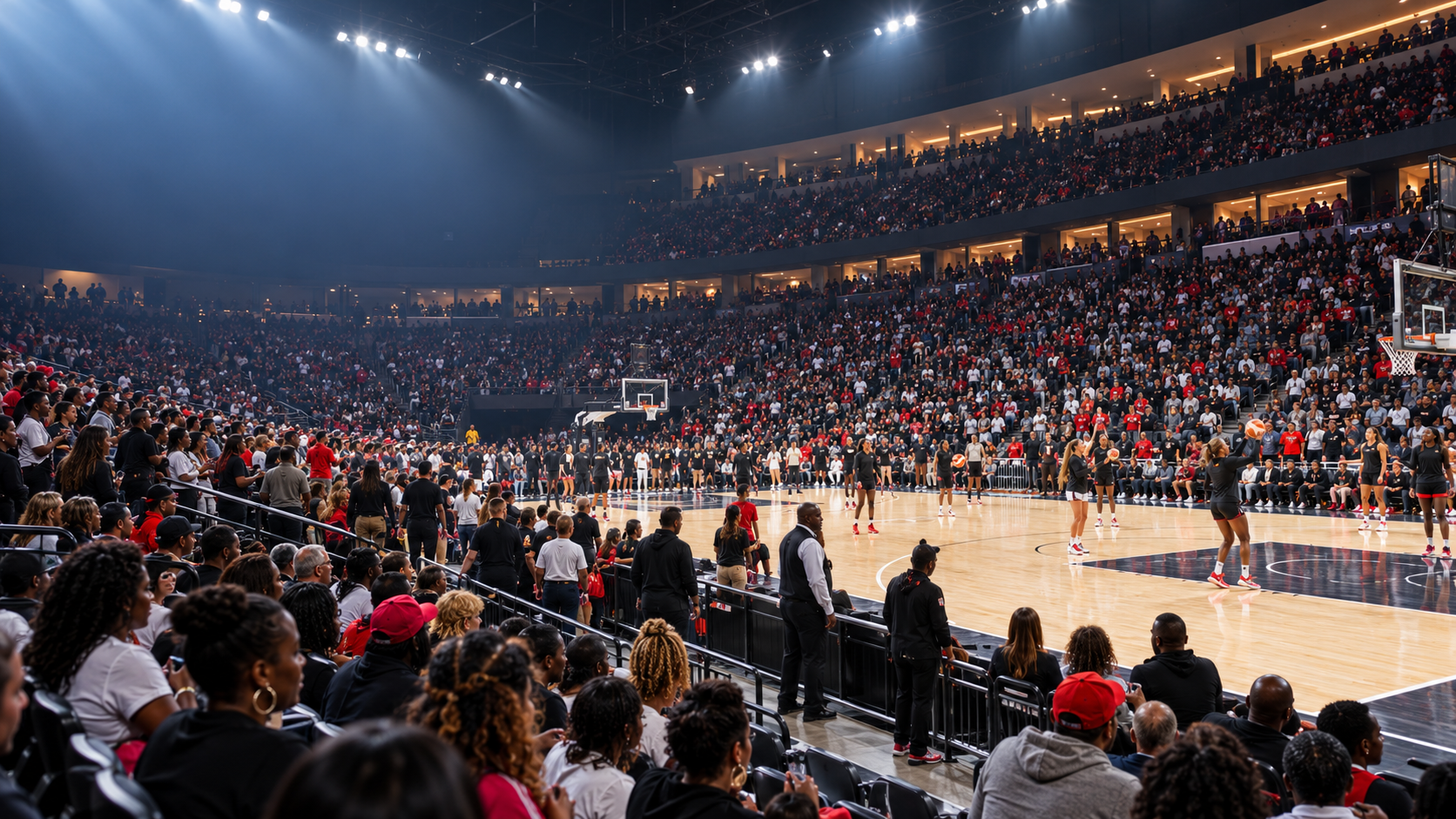
WNBA Finals Game 6 Live: Valkyries vs. Dream
WNBA Finals Game 6 Live: Valkyries vs. Dream
Live coverage status: The supplied source summaries do not verify the Game 6 score, result, player statistics, venue, tipoff time, broadcast details, or highlights.
Last verified update: The Valkyries won Game 4 on the road, tying the WNBA Finals at 2-2. Source 4
Game 6 Score and Status
- Valkyries: Not verified
- Dream: Not verified
- Game status: Not verified
- Series status: Game 4 ended with the series tied 2-2. The supplied summary does not state the Game 5 result.
ESPN provides live Game 6 coverage with updates, analysis, and highlights. Source 1
A live score should be published only after confirming the quarter, time remaining, possession, score margin, and timestamp from an authoritative live source.
Verification Checklist for a Live Score
The five required data points answer different questions, and each one changes how the number should be read. The quarter and clock establish whether the score is early, mid-game, or late enough for fouling and timeout strategy to distort normal play. Possession identifies which team has the next scoring opportunity and whether the margin is about to be tested. The margin itself determines intent: a one-possession game produces different decisions from a double-digit gap. The timestamp prevents an old number from being republished as current.
If any element is missing, the figure should be labeled provisional rather than presented as a live score. The safest wording is to state what the authoritative source shows at a stated time, not to describe the game state as settled.
Equally important, the series status is a separate field from the Game 6 score. The last verified series fact in the supplied material is 2-2 after Game 4. The Game 5 result is absent from the summaries, so the series cannot be described as leading toward elimination or extension until that result is confirmed and cited.
Game Information
The supplied summaries do not verify Game 6’s date, tipoff time, venue, broadcast channel, streaming platform, officials, starting lineups, or injury designations. These details should be confirmed through the official league listing or ESPN before publication.
ESPN Singapore’s preview confirms that the Valkyries and Dream were preparing for Game 6, but the supplied excerpt does not provide additional verified details. Source 2
Publication Checklist for Game Details
Treat each logistical item as its own claim with its own source, because a preview that confirms the matchup does not confirm the surrounding details:
- Date and tipoff time: confirm from the official league listing; times are frequently listed in a local or venue time zone.
- Venue: confirm the building and the home team designation, since a neutral-site or shifted venue changes the framing.
- Broadcast channel and streaming platform: verify separately from the existence of live coverage; carriage differs by market.
- Officials: confirm the assigned crew if the report intends to discuss foul counts or rule applications.
- Starting lineups and injury designations: confirm through official team information, not inference from a prior game.
A report that cannot source one of these items should say so explicitly rather than fill the gap.
Live Update Timeline
No verified Game 6 play-by-play was included in the supplied material. A complete live report should document the opening tip, scoring runs, timeouts, quarter scores, halftime statistics, turning points, and final possessions using the official live record.
Each update should include:
- Time remaining and score.
- Possession and the relevant play.
- Players involved.
- Tactical context.
- The effect on pace, shot selection, or the series.
Anatomy of a Single Live Entry
The bullets above form a sequence. Time and score establish the state of the game. Possession and the play describe the event. The players involved allow attribution and later cross-checking against the box score. Tactical context explains why the play mattered, for example whether a switch, a double team, or an offensive rebound created the look. The final bullet connects the event to the larger analysis.
An entry without the state of the game cannot be verified later. An entry without context reads as a bare scoreboard and provides no basis for the analysis sections below. Both belong in the same paragraph, in that order.
Game 6 Analysis Framework
Pace and Transition
The analysis should measure transition possessions, live-ball turnovers, early-clock attempts, and half-court possessions. Fast-break opportunities can create high-value shots before the defense is organized, while deliberate possessions may favor teams with reliable half-court creators.
Turnovers and Extra Possessions
The key indicators are total turnovers, points off turnovers, offensive rebounds, second-chance points, steals, and deflections. The impact depends not only on the totals but also on where turnovers occur and whether they lead to transition scoring.
Shot Selection and Defensive Execution
Shot quality should be assessed through paint scoring, three-point attempts, free throws, and the difference between open and contested attempts. Defensive analysis should consider pick-and-roll coverage, on-ball pressure, help rotations, paint protection, defensive rebounding, and late-clock possessions.
Bench Impact and Foul Trouble
The final report should identify how reserve units affect ball movement, spacing, rebounding, defensive pressure, transition offense, and turnover control. Foul-related analysis requires confirmed foul counts and the applicable league rules.
Reading the Four Indicators Together
These categories are not independent. Transition opportunities follow from turnovers and from defensive rebounding, so a team that wins the turnover battle usually gains early-clock attempts as a by-product. Shot quality follows from pace: a stretched defense concedes paint touches and open threes, while a set defense forces late-clock attempts. Bench foul trouble compresses rotations and can change coverage assignments.
Because of that overlap, a report should not list each indicator as if it carried equal weight. It should identify which indicator actually separated the teams and support that conclusion with the box score and play-by-play. A team can win the turnover margin and still lose the shot-quality comparison, and the report should say so when the record shows it.
Key Players and Performances
No Game 6 player statistics, confirmed starters, injury updates, or verified individual performances were supplied. Leading scorers, assist leaders, rebounders, defensive contributors, and late-game performers should be identified from the official box score.
Player evaluation should consider shooting efficiency, shot creation, passing under pressure, defensive assignments, rebounding position, turnover control, and fourth-quarter execution. Claims about screens, deflections, box-outs, loose-ball recoveries, or defensive rotations require official statistics or verified replay review.
Standards for Individual Evaluation
Each criterion depends on data that a highlight package does not supply. Shooting efficiency needs attempts as well as makes. Shot creation needs context about the defender and the clock. Passing under pressure needs assist and turnover figures. Defensive assignments need matchup information. Rebounding position needs more than a total. Fourth-quarter execution needs the play-by-play sequence.
Where those inputs are missing, the report should describe the performance only in terms the available source supports, or leave the evaluation open until the box score is published.
Three Factors That Could Decide Game 6
ESPN Singapore’s preview broadly identifies three themes for the matchup. Source 2
- Pace and transition opportunities: Which team creates early offense without sacrificing defensive balance?
- Turnovers and extra possessions: Which team protects the ball, wins the offensive-rebounding battle, and converts mistakes into points?
- Shot selection and defensive execution: Which team generates efficient attempts while limiting paint touches, open threes, and second chances?
These factors should be supported by the official box score and play-by-play rather than inferred from an unverified score.
The three themes overlap by design. Pace is produced by turnovers and rebounds, and shot quality is produced by pace. That means the decisive factor is often the one that feeds the other two on a given night, not the one with the largest raw total.
How Game 4 Changed the Series
The Valkyries’ Game 4 road win tied the Finals at 2-2. Source 4
The result increased the importance of the remaining games and showed that the series could not be assessed through home-court expectations alone. The supplied summary does not state the Game 5 result. ESPN’s Game 5 coverage should be checked directly before adding its score, performers, or tactical developments. Source 3
What Remains Unverified About the Series
The supplied material confirms one series fact: Game 4 went to the Valkyries on the road, leveling the Finals at 2-2, and that result shifted momentum and forced a decisive finish. Source 4
Everything between that result and Game 6 is unconfirmed in the supplied summaries: the Game 5 score, the players who decided it, and the tactical adjustments that followed. Because the series is a sequence, any Game 6 framing that depends on the Game 5 outcome is incomplete until that coverage is checked. The same applies to describing Game 6 as an elimination game or as an extension opportunity; the verified result of the preceding game determines which description is accurate.
Verified Highlights
No verified Game 6 highlights were supplied. A publication-ready highlights section should identify the best offensive play, defensive play, team sequence, and late-game moment, with the time, score before and after, players involved, defensive context, and source for each event.
Crowd reactions, player emotions, and quotes should be included only when confirmed by authorized coverage.
Criteria for Selecting Highlights
Selection should follow function, not spectacle. The best offensive play should show how a team created a high-value attempt. The best defensive play should show the coverage or rotation that produced the stop. The team sequence should show a run that changed the margin. The late-game moment should show the possession that decided the result.
Each selection needs the same supporting fields: time, score before and after, players involved, defensive context, and the source. A clip without those fields is an anecdote, not evidence, and cannot be used to support the analysis sections above.
Final Score and Box Score
- Final score: Not verified
- Series score: Not verified
- Leading scorers: Not verified
- Rebounding leaders: Not verified
- Assist leaders: Not verified
- Shooting statistics: Not verified
Authorized highlights should be linked from ESPN or another official rights holder after verification.
Shooting statistics should be reported with attempts alongside makes, and with team totals alongside individual lines, so that efficiency and volume can be distinguished. A percentage without attempts does not describe shot selection.
FAQ
What is the current Game 6 score?
The supplied summaries do not include a verified score, quarter, time remaining, or possession. ESPN’s Game 6 live coverage is the identified source for those details. Source 1
Where can fans follow Game 6?
Fans should use the authorized ESPN live coverage identified in the supplied material. Broadcast and streaming details require separate verification.
What was the series score before Game 6?
Game 4 tied the series at 2-2. The supplied summary does not state the Game 5 result.
What are the key factors in Game 6?
The available preview highlights pace and transition opportunities, turnovers and extra possessions, and shot selection or defensive execution.
Who are the key players to watch?
The supplied material does not confirm the starters, injury designations, or Game 5 performers. Those details should be checked against official team information and the ESPN box score.
What happens after Game 6?
The verified result will determine whether the Finals end in Game 6 or continue to another game.
Why are details labeled “not verified”?
The supplied summaries contain no Game 6 score, statistics, venue, or broadcast data. Labeling those fields prevents an unconfirmed number from being republished as a live figure, and it shows readers exactly which claims have a citation behind them.
Can social media posts confirm the score?
No. A score should come from an authoritative live source with a timestamp. Posts may be delayed, edited, or describe a different game state, so they cannot substitute for the live record.
How should a reader use this file before the final box score?
The verified content is the Game 4 result and the 2-2 series status. Everything else should be treated as a checklist of what to confirm once the official score, play-by-play, and box score are published.
Correction and Update Policy
When verified Game 6 details become available, the live status block at the top of this file should be updated first, with a timestamp. The timeline should then be rebuilt from the official play-by-play, and the analysis sections should be revised to match the confirmed box score.
The Game 4 result remains the last verified series fact until the Game 5 outcome is sourced. Earlier “not verified” labels should be replaced with sourced detail rather than removed silently, so readers can see what changed and why.